
Artisan equipment in Stardew Valley transforms basic crops into high-value artisan goods. Whether you’re turning fruit into wine or vegetables into pickles, choosing the right machine boosts your long-term profit dramatically.
This guide breaks down the differences between Preserves Jars, Kegs, and Beehouses, including processing times, crafting costs, and the most profitable products for each machine.
For more Stardew Valley guides, you may also enjoy:
Preserves Jars – Fast Processing & Reliable Income
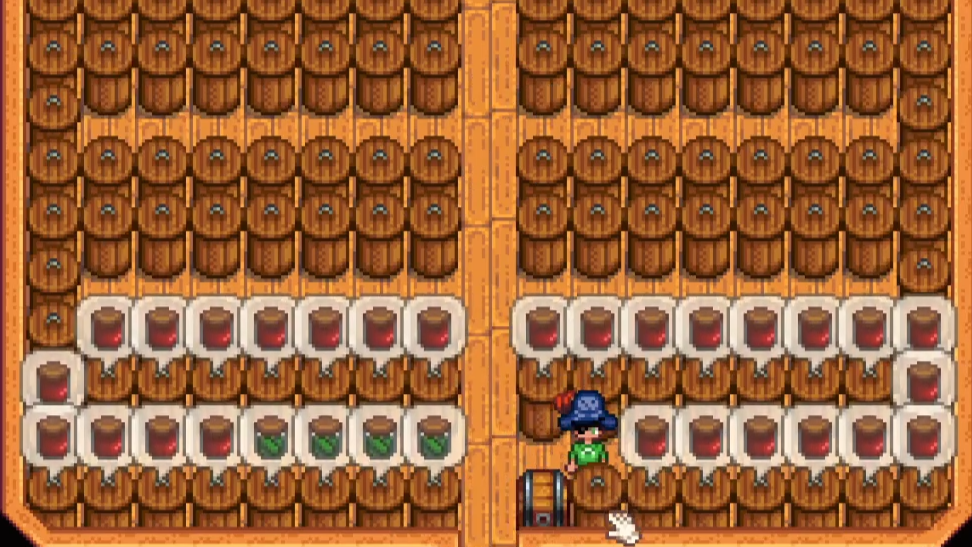
Preserves Jars are perfect for bulk farming because they ignore crop quality — a low-quality vegetable still produces the same quality pickles. This makes them excellent for turning inexpensive crops into high-value artisan goods.
⏱ Processing Time
- Pickles / Jelly: 4000 minutes (2–3 days)
- Aged Roe: 4000 minutes (2–3 days)
- Caviar (Sturgeon Roe): 6000 minutes (4 days)
🍓 Products & Profit Formula
- Pickles: Any vegetable → 2 × base vegetable price + 50g
- Jelly: Any fruit → 2 × base fruit price + 50g
- Aged Roe: Roe → 2 × base roe price
- Caviar: Always sells for 500g
🛠 Crafting Recipe
- 50 Wood
- 40 Stone
- 8 Coal
- Unlocked at: Farming Level 4
The main limiting factor is coal, since Preserves Jars require 8 pieces each — the same cost as Beehouses.
Kegs – Highest Profit for Wine & Specialty Drinks
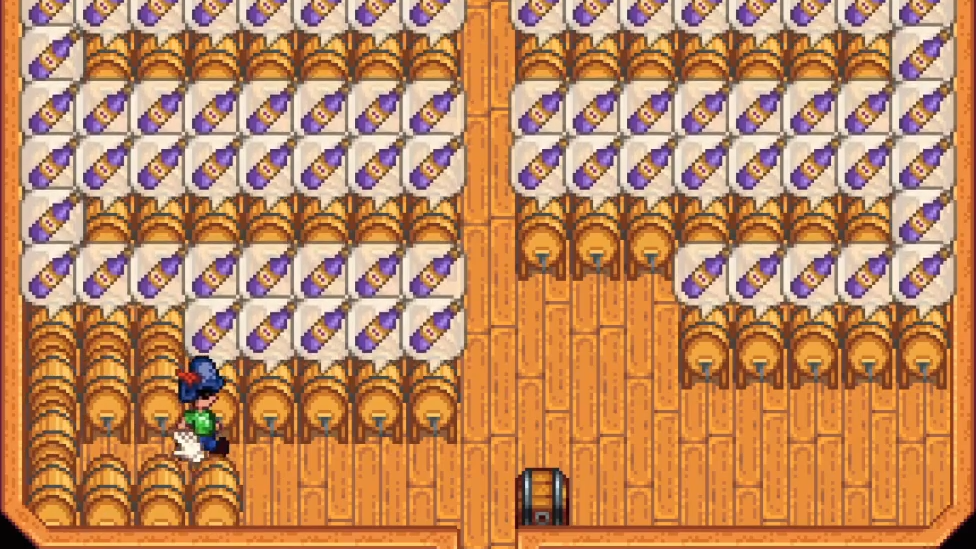
Kegs offer the best late-game profit thanks to wine production, especially when using high-value crops. They also produce beer, coffee, tea, juice, and mead, each with unique processing times.
⏱ Processing Time
- Beer: 1750 minutes (≈1.1 days)
- Vinegar: 600 minutes (10 hours)
- Coffee: 120 minutes (2 hours)
- Green Tea: 180 minutes (3 hours)
- Mead: 600 minutes (10 hours)
- Pale Ale: 2250 minutes (≈1.4 days)
- Juice: 6000 minutes (4 days)
- Wine: 10000 minutes (6.25 days)
💰 Best Crops for Profit
- Ancient Fruit Wine: 2310g
- Starfruit Wine: 3150g
These are some of the highest-profit items in the game. After unlocking the cellar, wine can be aged in casks to reach Iridium quality for even greater returns.
🛠 Crafting Recipe
- 30 Wood
- 1 Copper Bar
- 1 Iron Bar
- 1 Oak Resin
- Unlocked at: Farming Level 8
Because kegs do not require coal, they are much easier to mass-produce than Preserves Jars or Beehouses.
Beehouses – Passive Honey Production

Beehouses generate honey every 4 days (except in Winter). Their selling price depends on nearby flowers — the closest flower within 5 tiles determines the honey type.
🌼 Honey Types & Sell Prices
| Flower Honey Type | Season | Sell Price |
|---|---|---|
| Wild Honey | All but Winter | 100g |
| Tulip Honey | Spring | 160g |
| Blue Jazz Honey | Spring | 200g |
| Sunflower Honey | Summer / Fall | 260g |
| Summer Spangle Honey | Summer | 280g |
| Poppy Honey | Summer | 380g |
| Fairy Rose Honey | Fall | 680g |
Fairy Rose Honey is the most profitable. On Ginger Island, flowers never die — meaning you can produce Fairy Rose Honey all year long.
🛠 Crafting Recipe
- 40 Wood
- 8 Coal
- 1 Iron Bar
- 1 Maple Syrup
- Unlocked at: Farming Level 3
Preserves Jars vs Kegs vs Beehouses – Which Should You Choose?
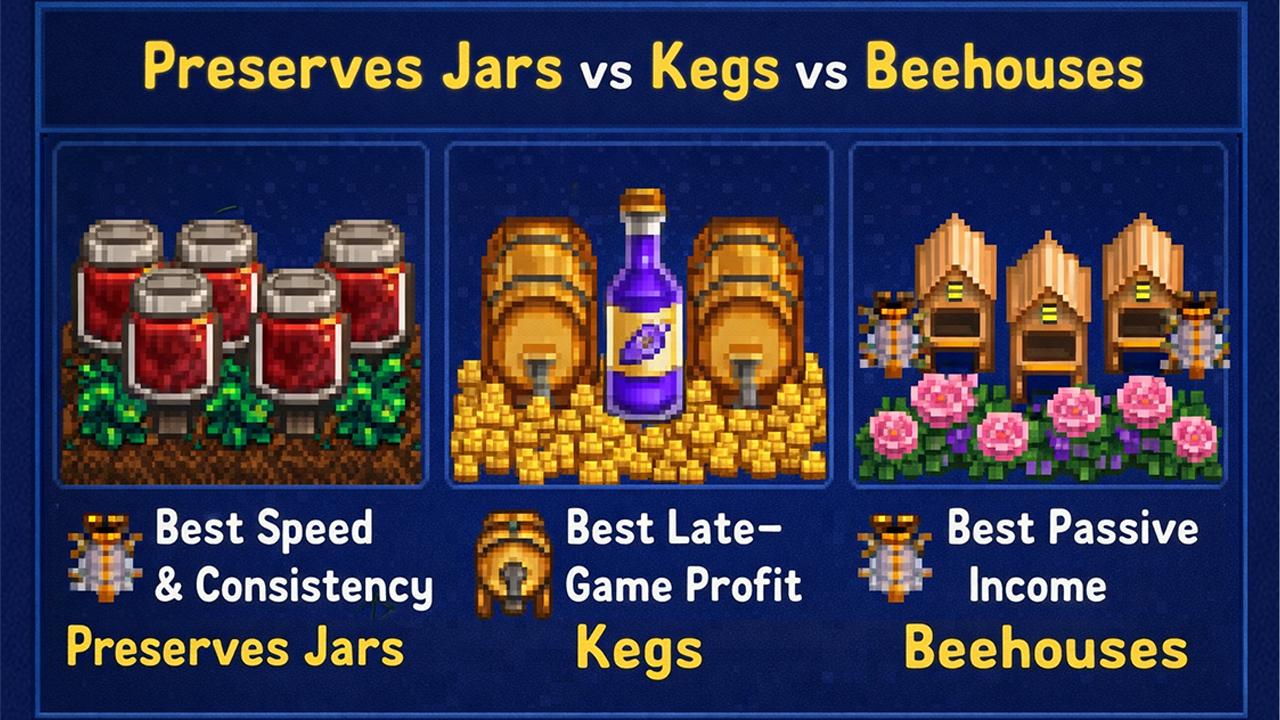
🏆 Best Late-Game Profit: Kegs
Wine made from starfruit or ancient fruit offers the highest income potential, especially when aged in casks.
⚡ Best Speed & Consistency: Preserves Jars
Fast 2–3 day cycles and predictable profits make them ideal for large vegetable farms.
🌼 Best Passive Income: Beehouses
Place them near Fairy Rose for huge returns, or use Ginger Island for year-round honey.
Final Verdict
Each artisan machine shines in different situations:
- Preserves Jars — great early and mid-game, fast turnaround.
- Kegs — exceptional late-game profit with wine.
- Beehouses — perfect passive income, especially with Fairy Roses.
If you’re optimizing your farm layout, consider starting with Preserves Jars, expanding into Kegs for end-game income, and adding Beehouses once you unlock Ginger Island.
Thanks for reading! Explore the related guides above to take your Stardew Valley farming to the next level.